
Annual Letter on Philanthropy
Mike Bloomberg
“A rapidly growing share of the global population lives in cities. When mayors succeed, millions of lives improve.”
Our company has offices across 69 countries, and all of them are designed in the same way. There are no walls between teams and no private offices, not even for me. Everyone has the same size desk. Central common areas offer snacks and coffee, and bold works of art add color and dynamism.
The purpose of this approach is to bring people together to foster conversation, spark creativity, and share ideas. It has been a central part of our company’s culture since our founding in 1981, and it has been part of the Bloomberg Philanthropies’ culture since its inception, too. But this open office plan wasn’t our invention. In fact, it is rooted in a model nearly as old as recorded history itself: the city.
Cities create a special kind of alchemy. People from different backgrounds and holding different perspectives come together on sidewalks, in public parks, and in markets. They fall into conversation, learn from one another, and find common ground in unexpected places. When our team brought the open office plan to New York City Hall, reporters could hardly believe it. But there was no more natural place for it. City halls, like the cities they govern, should offer fertile ground for discovery, innovation, and entrepreneurial activity. That can only happen if mayors tear down barriers and create a culture where open communication, healthy debate, and idea-sharing can thrive.
Until recently, however, the dynamic mixing of ideas that defines the best cities has mostly happened within them, not among them. Bloomberg Philanthropies has been working to change that by building something entirely new: a global infrastructure for mayors and local leaders to collaborate with their peers and leading experts. And as global challenges like climate change and public health crises grow more complex, openness is more critical than ever.
Our mission is to help the greatest number of people live better, longer lives — and mayors are natural partners. While national governments are too often gripped by partisan gridlock, mayors don’t have the luxury of playing politics. They are responsible for delivering the essential services that people depend on every single day, which tends to make mayors more open to new ideas — and more willing to engage in creative experimentation and risk-taking. We are empowering local leaders to do both through a variety of ways.
Strengthening Leadership
Running a modern city can be more complex than running a major corporation. But executive training, which is common in the private sector, was historically rare in the public sector. Ten years ago, we created the Bloomberg Harvard City Leadership Initiative to change that, and it has since grown into the world’s premier training ground for local government leaders. More than 500 mayors and 3,650 senior leaders from across local governments have participated in the program. To expand its impact, we recently launched a similar program for mayors across Europe, in partnership with the London School of Economics and the Hertie School in Berlin.
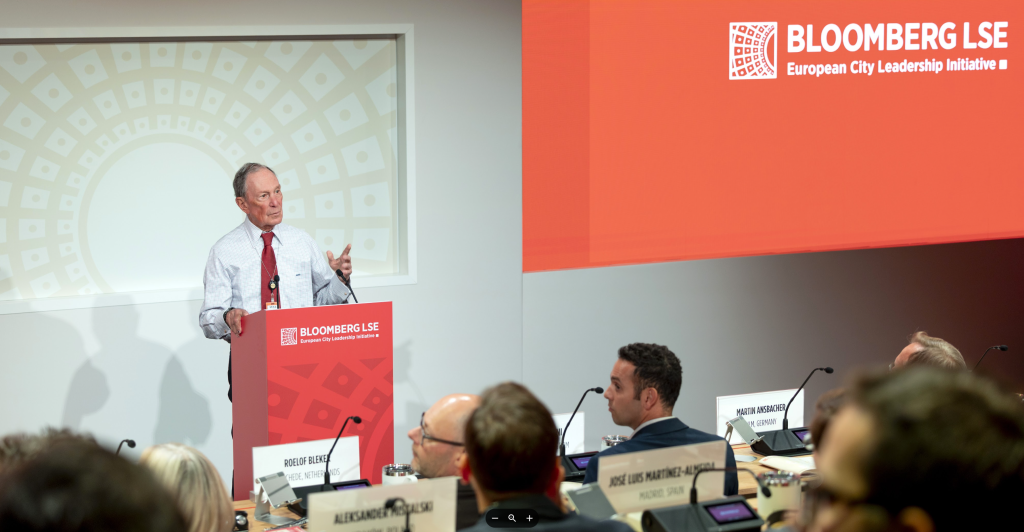
Mike spoke to the inaugural class of mayors of the Bloomberg LSE European City Leadership Initiative in October 2025.
Elevating Ideas
Throughout each year, we create opportunities for idea-sharing, including CityLab, an annual conference hosted in partnership with the Aspen Institute. It’s a chance for mayors, civil servants, and private sector leaders to gather face to face to share ideas, experiences, lessons, and insights. We’ve also worked to find and highlight creative solutions to difficult problems through the Mayors Challenge, which invites cities to tackle common problems in new ways. In 2026, we announced 24 new winners from 20 different countries, covering everything from affordable housing to flood protection. More than 375 cities have adopted ideas that have emerged from the six Mayors Challenge competitions we’ve held. Similarly, our Public Art Challenge invites cities to team up with artists to address pressing local issues. To further accelerate the spread of successful models, we recently launched the Bloomberg Cities Idea Exchange. Its goal is to find and elevate great ideas and make it easier for more cities to adopt them, including by providing the in-depth information and technical assistance they need to adapt and implement them.
Identifying Unmet Needs
We’ve seen how some of the most persistent and harmful problems often fail to garner much attention from governments and foundations. One example is road safety. More than one million people die each year in road crashes, mostly in low- and middle-income countries. As cities began pioneering interventions, such as better road design and stronger enforcement, we have helped the policies spread around the world — and encouraged national governments to act, too. Since 2007, we’ve helped pass nearly 200 road safety measures that together have helped to save nearly one million lives. But there is much more to do. And so this year, we are making an additional investment of $350 million, with the goal of helping to save another one million lives over the next five years.
Using Data
Data can reveal the causes of problems that might otherwise remain invisible. We are helping cities harness and deploy this data, along with artificial intelligence and other emerging technologies. Through What Works Cities and the City Data Alliance, we are giving cities more tools to capture and utilize critical data. To date, 80 cities from 12 countries have participated in the City Data Alliance, focusing on using AI and digitizing city services. Another program, Breathe Cities, is equipping local leaders with precision air quality sensors to zero in on neighborhood-level pollution. The data has given cities the evidence they need to pass lifesaving policies that cut pollution. For example, levels of toxic nitrogen dioxide — which comes from burning fossil fuels, including in cars and trucks — have fallen by around 14 percent in participating cities. To build on this progress, we are now expanding the program to more cities worldwide.
Building Networks
Across all of these efforts, we’ve built a global network of leaders to accelerate the sharing of ideas, information, and lessons, helping good policies and programs spread and scale in ways that benefit millions more people. For instance: The network of colleges and universities that we created through the American Talent Initiative is helping more students from low- and middle-income families apply for, afford, and graduate from many of the nation’s best public and private institutions. And through the Partnership for Healthy Cities, more than 70 mayors are leading the charge against noncommunicable diseases like cancer, diabetes, and heart disease, proving that death from these illnesses can be prevented.
A rapidly growing share of the global population lives in cities. When mayors succeed, millions of lives improve. When leaders collaborate across borders, progress accelerates. The idea that leaders can and should mix as freely across countries as people mix across neighborhoods is no longer theoretical. It is happening. With every shared idea, every tested innovation, and every life saved, we see the benefits of cooperation and collaboration.
Cities have always been places where the future is built. And in a century that will be shaped by urban growth and global challenges, empowering mayors and local leaders is one of the most effective investments we can make.
Sincerely,

Michael R. Bloomberg
Founder
Bloomberg Philanthropies
Follow on:


